[ AGENTIC AIOps ]LIVE
Resolve™
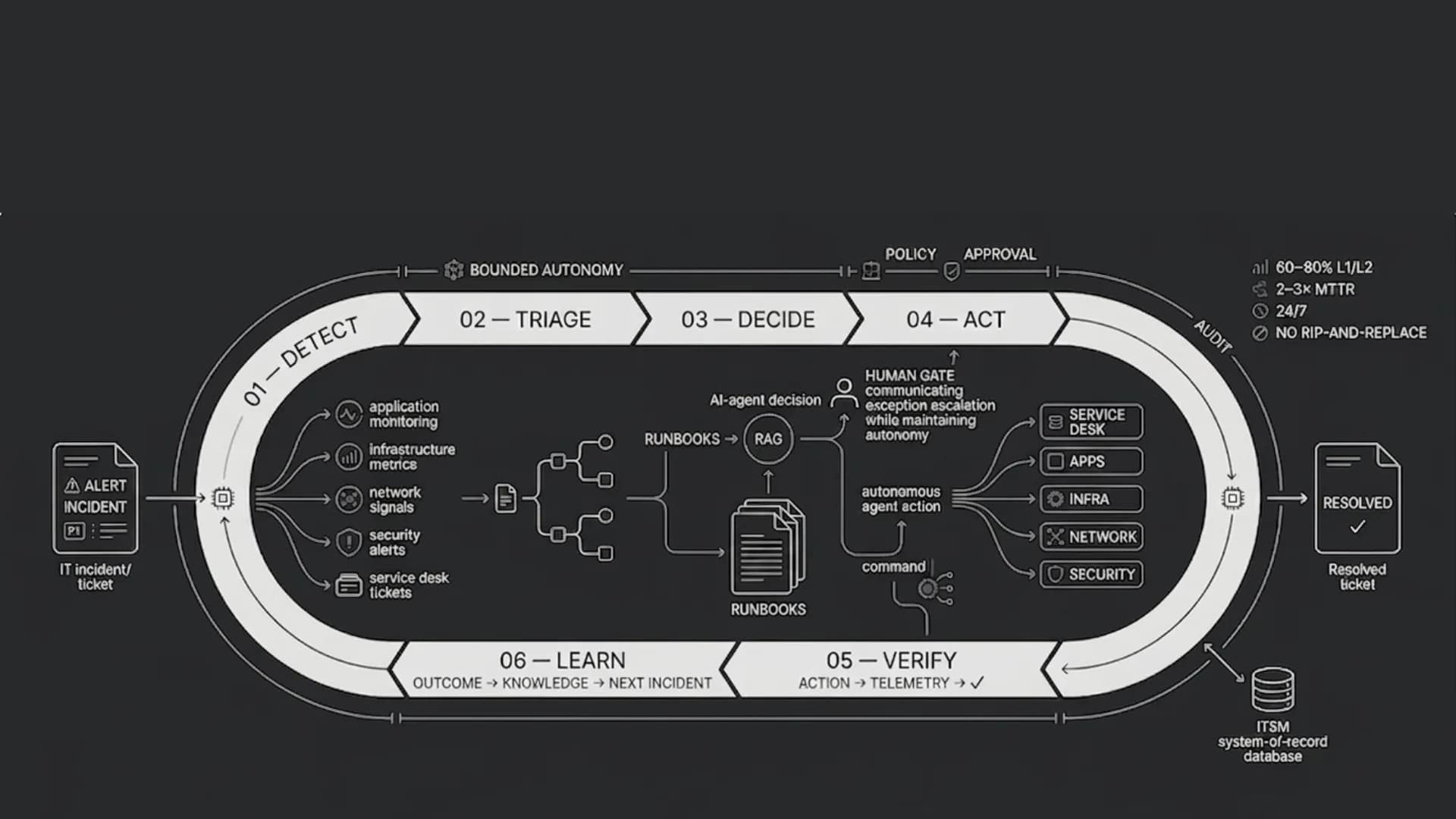
Run IT operations as outcomes, not headcount. A governed fleet of agents detects, triages, decides and acts across service desk, applications, infrastructure, network and security — while humans supervise the exceptions and the incumbent ITSM stack stays the system of record.
// Problem
The Problem
Level-one and level-two operations consume the majority of an IT organisation's people budget while producing none of its differentiation. The work is repetitive, well-documented and still slow, because a runbook is only as fast as the human reading it — and out of hours, it isn't read at all. Automation projects address the top ten ticket types and stall, because the eleventh requires judgment about an unfamiliar system state.
- Mean time to restore is bounded by human availability, not by how hard the problem is.
- Runbook knowledge is written down but not executable, so it degrades as staff turn over.
- Traditional automation covers the head of the distribution and leaves the long tail untouched.
- Out-of-hours incidents wait for a person regardless of severity.
// Overview
Resolve operates as a closed loop over the existing operations estate. Agents ingest signals and tickets, triage against a retrieval layer grounded in the organisation's own runbooks and prior resolutions, decide on an action within a bounded-autonomy policy, execute against the relevant system, verify the restored state, and write the outcome back as new grounding for the next occurrence. Incumbent ITSM, monitoring and configuration tooling are retained — Resolve acts through them. Autonomy is scoped per action class, so read and diagnose are broadly permitted while change actions are gated according to blast radius.
// AI System
Why AI
The long tail is the entire argument for agents. Scripted automation must anticipate its trigger; the tail cannot be anticipated, which is why it stays manual. A retrieval-grounded agent can read an unfamiliar state, find the closest prior resolution in the organisation's own history, and reason to an action — and where it cannot reach confidence, escalate with a diagnosis already attached, so the human starts from a hypothesis rather than a blank ticket. The learning loop is what compounds: every resolution, human or agent, becomes grounding for the next one.
// Specs
Specifications
- SCOPE
- Service desk, applications, infrastructure, network, security
- AUTONOMY
- Bounded per action class; change actions gated by blast radius
- GROUNDING
- Retrieval over the organisation's own runbooks and resolution history
- COVERAGE
- 24/7
- SYSTEM OF RECORD
- Incumbent ITSM retained; no rip-and-replace
// Features
Features
- 01Closed loop from detection through verification, not a triage assistant that hands off.
- 02Retrieval grounded in the organisation's own runbooks and prior resolutions, with citations.
- 03Autonomy scoped per action class, so diagnosis is free and change is gated.
- 04Escalations arrive with a diagnosis and evidence attached, not as a raw ticket.
- 05Every resolution written back as grounding, so coverage compounds with use.
- 06Operates through incumbent ITSM, monitoring and configuration tooling.
// Architecture
Architecture
RESOLUTION LOOP
Runtime · one item, left to right
- 01Signal / Ticket Intake
- 02Grounded Triage
- 03Decision + ConfidenceService DeskApplicationsInfrastructureNetworkSecurity
- 04Action Execution
- 05State Verification
- 06Write-Back to Grounding
dashed = the inference step, where the system exercises judgment
System stack
Data in · decisions out
01
Sources
Signals across the estate
02
Ingestion
Correlate before anyone reads
03
Ontology
Incident with its causes
04AI
Intelligence
Diagnose, act, verify
05Human
Human control
Authority is configured, not assumed
06
Actions
Written back
Observability
Every model call traced; evals run on real cases, not anecdotes.
Governance
Entitlements enforced at retrieval; rules versioned by the organisation.
Write-back
Systems of record are written only through the approval gate.
Below-confidence items escalate with diagnosis attached; the resolution returns to grounding either way.
// Impact
Impact
- 60–80%
- Autonomous L1/L2 resolutionindicative target
- 2–3×
- Faster mean time to restoreindicative target
- 24/7
- Coverage without shift coverdesign intent
Interested in Resolve?
Let's scope a bounded pilot against your ticket distribution.
Get in touch